

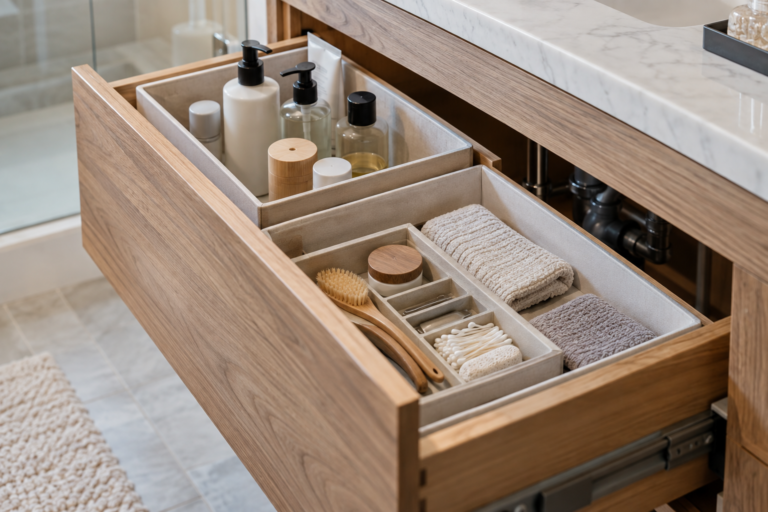
The most useful bathroom organization ideas put daily essentials near the place you use them, move refills out of the way, and leave enough empty space to clean. Start with the counter, then give drawers, the shower and cabinets separate jobs. Add storage only after measuring what actually needs a home.
A small bathroom does not need every organizer on this list. Choose the changes that solve a specific problem: crowded surfaces, hard-to-reach bottles, towels without a drying spot, or supplies you keep buying twice.
Bathroom organization ideas: Map your bathroom before buying storage
Sort your belongings into daily use, occasional use, refills and items that belong elsewhere. Record the inside width, depth and usable height of each drawer or cabinet. Note pipes, hinges and the space needed to open doors. An organizer’s outside dimensions matter more than its advertised capacity.
For a practical fit test, cut paper to the organizer’s footprint and place it in the intended location. Open the drawer, cabinet or bathroom door. Reach for the faucet and lift the tallest bottle. If any action becomes awkward, revise the layout before purchasing.
Original category map. Choose locations that suit reach, moisture and secure storage needs.
Keep the vanity and counter easy to use
1. Make one small daily-use station
Group only the products used at the sink each day. A washable tray makes them easier to lift when wiping the counter. If the tray blocks washing or sits in frequent splashes, move it to a drawer.
2. Preserve the space beside the basin
Leave a clear landing area for a hand, a washcloth or a temporary item. Test the space during your actual routine rather than choosing a decorative arrangement that crowds the faucet.
3. Move duplicate bottles into a refill zone
Keep one open bottle of each product near its point of use. Put unopened replacements together elsewhere. This reduces countertop crowding and makes duplicates easier to spot before shopping.
4. Choose upright storage for narrow objects
A small holder can contain brushes or combs without spreading them across a surface. Choose one that can be washed and allows damp items to dry; do not pack it tightly.
5. Give each person a portable routine kit
In a shared bathroom, use separate small caddies for personal products. Store them on a shelf or in a cabinet and bring out only the kit in use. This works when there is no room for permanent counter stations.
For three specific surface arrangements, see the counter layout guide.
Make drawers work for the objects inside them
6. Assign each drawer a task
Use one drawer for a morning routine and another for grooming or occasional products. Grouping by task saves you from opening several drawers to finish one job.
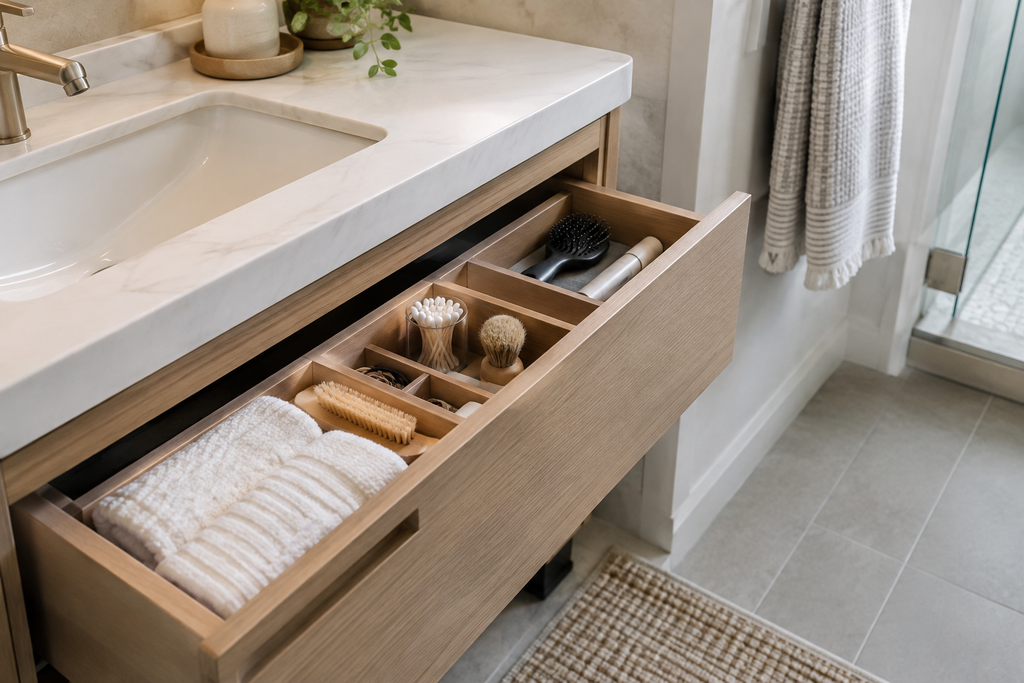
7. Divide small loose items
Separate hair ties, clips and other small pieces in shallow compartments. Choose removable dividers so the arrangement can change; a rigid grid is less useful if it leaves large objects without a home.
8. Keep everyday items in the front row
Put frequently used products nearest the drawer opening. Keep occasional items behind them, with labels visible. Avoid stacking an everyday item underneath something you must move first.
9. Use vertical space only in deep drawers
Stand suitable bottles upright in a deep drawer, after checking cap clearance. In a shallow drawer, lay closed items flat. A tray that fits the floor can still be too tall for the drawer to close.
10. Separate grooming tools from toiletries
Give tools their own compartment so they do not tangle with bottles. Let heated tools cool before storage and follow their instructions. For a complete reset and fit calculation, use the drawer organization steps.
Reduce clutter around the shower and toilet
11. Keep only current shower products in the shower
Move refills and products you rarely use to dry storage. A shower shelf becomes easier to use when it holds the current routine rather than the entire household inventory.
12. Choose shower storage that drains
Look for an open or draining base and clean it regularly. Avoid a closed basket that keeps products standing in collected water. Confirm that the holder suits its mounting surface.
13. Check shower door movement
Open the door fully and test access to controls before fitting a caddy. A holder that catches the door or forces an awkward reach is the wrong fit, even if it adds shelf space.
14. Give damp towels a drying place
Use a suitable rail or hook where towels can hang without bunching. Do not put damp towels into a closed linen basket. If one hook becomes a pile, give each towel its own location.
15. Keep a modest toilet-paper supply nearby
Store a few dry rolls where they are easy to reach. Keep the bulk pack elsewhere if it crowds the room. A floor basket is unsuitable where it regularly gets wet.
16. Use the toilet wall selectively
A properly installed shallow shelf can hold lightweight supplies without consuming floor area. Leave access to the tank and follow the shelf’s mounting and load instructions; the wall is not automatically suitable for every fixing.
Recover cabinet space without blocking access
17. Split the under-sink area around plumbing
Place removable bins on either side of the pipes and leave fittings accessible. Do not wedge containers against valves or use pipes to support storage. See the sample under-sink cabinet plan.
18. Use a removable tray beneath stored bottles
A washable tray makes small spills easier to see and clean. It does not repair a leak or make a damaged cabinet suitable for storage. Resolve moisture problems before returning supplies.
19. Add a shelf only where height is wasted
A freestanding riser can separate short items from taller bottles. Check its footprint, stability and rated load. Skip it if retrieving the bottom row requires unloading the top.
20. Store cleaning products securely
Keep cleaners in their original labeled containers and separate from personal-care supplies. Use secure storage inaccessible to children. Poison Control advises against container transfers and mixing household cleaners. [2, 3]
21. Move medicine out of humid storage
A bathroom is often unsuitable for medicines because of heat and moisture. Follow the medicine’s label and pharmacist’s advice, and use secure storage away from children. MedlinePlus explains these storage concerns. [1]
22. Keep towels and refills in distinct shelf zones
Put clean, dry towels together and unopened toiletries in a separate bin. A small bathroom closet benefits from category boundaries; the shelf-by-shelf closet plan shows where each category can go.
Add storage that suits a small bathroom or rental
23. Test an over-door organizer before filling it
Check that the door closes without rubbing and the organizer does not hit the frame. Use it for light, dry items within its rated capacity. Thick hooks do not suit every door gap.
24. Use removable hooks for appropriate light items
Follow the hook manufacturer’s surface, moisture, curing and weight instructions. Get permission where required in a rental. Removable adhesive does not guarantee damage-free removal on every finish.
25. Choose a narrow removable cart only if it leaves a clear route
Measure the cart including handles and wheels. Place it where cabinet doors still open and people can move comfortably. A cart that fills a circulation gap creates a new problem.
26. Use a dry shelf outside the bathroom for surplus linens
When the bathroom has little storage, relocate spare towels and bedding. The linen closet guide explains how to keep matching sets together and avoid lost items on deep shelves.
27. Give returned items a visible home
Labels should describe simple categories such as hair care or refills. Keep enough open space to put something back without rearranging the shelf. Organization lasts when returning an item takes one easy action.
Choose the next change by the problem you see
If surfaces are crowded, start with the daily-use station and refill zone. If drawers jam, measure their clearance and simplify compartments. If towels remain in piles, fix drying and linen storage. If the cabinet smells damp or has wet patches, investigate the moisture before adding bins.
At the end of the week, check whether the counter can be wiped without sorting, drawers close smoothly, towels have drying space and refills are easy to count. Keep the improvements that pass those tests. Remove organizers that merely relocate the clutter.
FAQs
What should I organize first in a small bathroom?
Start with the counter and the drawer you use most often. Remove unopened replacements and occasional products from those prime locations, then create separate homes for refills, dry towels and shower products.
How can I organize a bathroom without drilling?
Try removable bins, drawer inserts, portable caddies or a suitable freestanding unit. Test door clearance before using over-door storage, and follow surface and load instructions for any removable fitting.
How do I know whether I need more bathroom storage?
First remove unused products and measure the remaining categories. Add storage only when a specific group still lacks a suitable home. If existing organizers are difficult to reach or return items to, changing the layout may help more than adding capacity.
Conclusion
Choose bathroom storage from your daily routine and the space you can actually use. Begin with one clear counter station, divided drawers and a separate refill zone, then address towels, shower supplies and cabinet access. Keep the changes that make products easier to find and return. A successful arrangement leaves the bathroom usable, cleanable and straightforward to maintain.
