

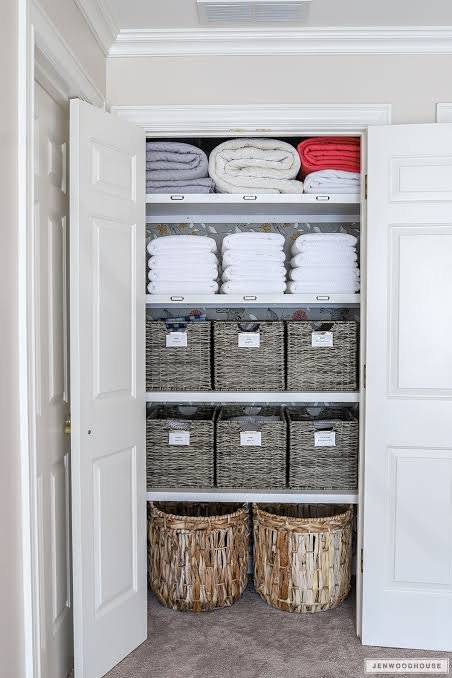
Linen closet organization ideas work best when you group linens by bed size or purpose, fold them to fit the shelves and keep regularly used sets within easy reach. Put occasional items higher or farther back, with labels that make them easy to identify. Decide how much to keep from laundry needs and available space rather than a universal quantity rule.
These linen closet organization ideas address misplaced matching pieces, collapsing stacks and deep shelves where supplies disappear. A useful arrangement allows you to remove one set without rebuilding the shelf.
Linen Closet Organization Ideas: Choose Quantities and Categories
1. Inventory each bed size separately
Count complete usable sets for every bed. Set aside unmatched pieces before deciding whether they still have a purpose.
2. Choose quantities from your laundry cycle
Two sets per regularly used bed can be a starting plan: one in use and one available. Add another if drying time, frequent changes or household needs justify it. This is an adjustable planning example, not a hygiene standard.
3. Set towel quantities by actual use
Count the towels in use and the replacements needed during laundry. Add a guest allowance only if useful. Avoid a large reserve that prevents the active supplies from fitting.
4. Separate guest linens from everyday linens
Keep guest bedding in a labeled group. It should not occupy the easiest shelf if everyday sheets are difficult to reach.
5. Remove unsuitable or unused linens
Reassign serviceable pieces deliberately, such as keeping a few cleaning cloths in their own location. Do not let an unlimited just-in-case pile take over the closet.
Linen Closet Organization Ideas: Fold for the Shelf
6. Measure the shelf before folding
Record usable width, depth and height. Include the door swing and any rear obstruction; the folded stack must fit within that real footprint.
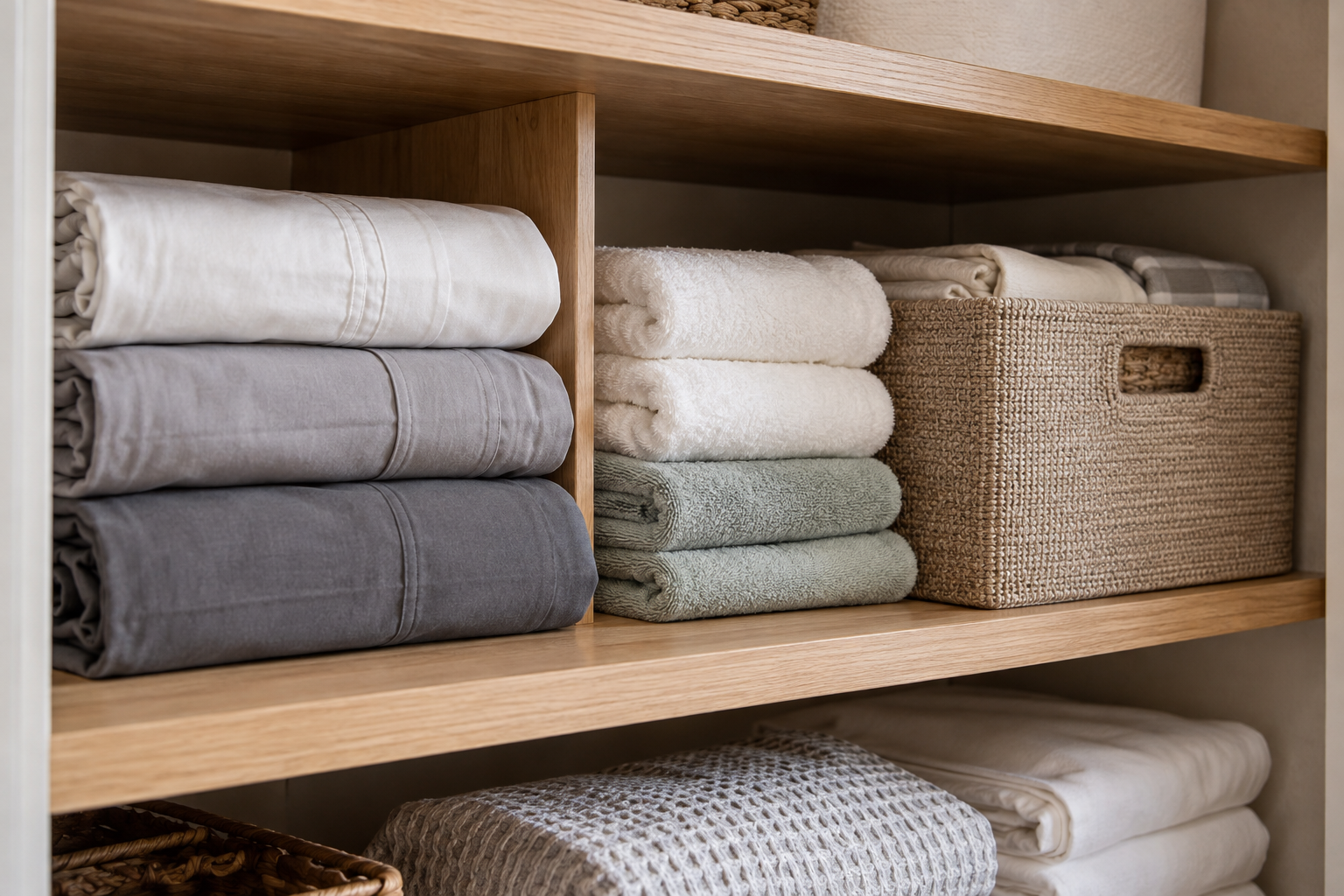
7. Fold towels into shelf-sized rectangles
Bring edges inward until the towel fits the shelf depth, then fold into a manageable stack. If towels hang over the edge, change the fold before adding a basket.
8. Roll only where rolls stay contained
Rolled washcloths may work in an open bin. Loose rolls on a broad shelf can spread or unwind, so use the method only where it improves retrieval.
9. Bundle matching sheet sets
Fold the flat and fitted sheets together and tuck their matching pillowcases with them. A pillowcase can contain a set if it fits without tight stuffing. Label by bed size rather than relying only on color.
10. Fold fitted sheets around their bulky corners
Tuck the corners into one another, flatten the elastic edge and fold the resulting shape to the shelf footprint. It need not be perfect; keeping the set together matters more than identical folds.
11. Keep stacks low enough to remove one item
If the top pieces tumble whenever you pull a towel, divide the stack or add an appropriate divider. The right stack height depends on the linen’s bulk and the shelf spacing.
Make shelf depth and height usable
12. Keep active supplies at the front
Place the linen category used most often near the opening. Do not bury this week’s spare sheets behind guest bedding.
13. Use rear space for labeled occasional items
A removable rear bin can hold seasonal linens. Its label should be visible when the front bin comes out. Skip two-row storage if the rear row cannot be reached comfortably.
14. Add dividers where categories collapse together
Use dividers to separate towel stacks or bed sizes. Verify their fit and do not force clip-on dividers onto shelves they are not designed to suit.
15. Adjust shelf spacing when the system allows
Match spacing to your tallest folded category, with room for your hand. Follow the shelving instructions and avoid placing heavy items high or exceeding shelf ratings.
16. Keep blankets in their own zone
Use a larger removable container or dedicated shelf. A thick blanket placed on a small towel stack makes the towel category harder to retrieve.
17. Label the shelf edge as well as hidden containers
Shelf labels help people return clean laundry to the right place. Use plain descriptions such as queen sheets or guest towels and update them when the arrangement changes.
18. Protect empty space for returns
Leave room to replace a complete set after laundry. If you must compress everything to close the door, edit quantities or move an occasional category elsewhere.
Linen Closet Organization Ideas: A Shelf Map and Folding Test
For an illustrative 30-by-16-inch shelf, two towel stacks around 12 inches wide and 13 inches deep leave 6 inches across the shelf and 3 inches behind them. Actual towel sizes and folds will vary. Test with your clean towels, then check that the front edge is clear and both stacks are easy to grip.
On a deep shelf, a front bin for active sheets and a removable rear bin for guest supplies can work better than a single long stack. On a shallow shelf, one visible row is usually simpler. For small linen closet organization, reduce retained duplicates before trying to create more layers.
Reset the closet after laundry
Return complete sets to their labeled zones and move the next clean set forward. Replace the towel stack without mixing guest and daily supplies. If a category does not fit, check whether an extra item has entered it or the fold has become too bulky.
Keep bathroom toiletries on separate shelves or in a bathroom closet arrangement. If clothing also shares the space, the small closet storage guide helps decide which categories need hanging, drawers or shelves. For towel placement inside the room itself, return to the bathroom organization hub.
FAQs
How many sheet sets should I keep?
Use your laundry cycle and household needs to decide. Two sets per regularly used bed can be a starting plan: one in use and one available. Add more when drying time or frequent changes justify them, while checking that the sets still fit.
How do I stop items getting lost on deep linen shelves?
Keep active linens at the front and put occasional supplies in a labeled removable rear bin. Avoid loose hidden piles. If reaching the rear requires unloading the whole shelf, use fewer layers or move that category elsewhere.
Should towels or sheets be stored damp?
No. Return fully dry linens to enclosed storage and give damp towels a suitable drying location. If the closet has persistent moisture, investigate its cause rather than tightly packing bins around it. The EPA’s moisture guidance explains why controlling dampness matters. [
Conclusion
Good linen closet organization ideas bring together complete sets, usable shelf dimensions and realistic quantities. Choose folds that fit the space, keep daily supplies visible and label occasional items that sit farther back. Return laundry to its defined zone and preserve enough room for a complete clean set. The closet works well when you can remove what you need without disturbing every stack.
