


Practical pantry organization ideas group food by how you use it, keep everyday ingredients visible and place older stock where it will be used first. Start by sorting what you already have, assigning a few food zones and measuring your shelves. Buy containers only after you know which storage problems they need to solve.
An organized pantry does not require every package to match. It needs to answer three questions quickly: what is available, where does it belong and what should be used next? A workable arrangement also leaves room to unload groceries without dismantling the shelves.
Pantry organization ideas: Inventory food before changing the layout
Work shelf by shelf if emptying the whole pantry would overwhelm your kitchen. Sort food into meal staples, breakfast, snacks, baking, canned goods and reserve stock. Separate opened packages from unopened duplicates so you can see the true quantity.
Check each product’s storage instructions and condition. Pantry space is for food suitable for room-temperature storage; a package labeled for refrigeration needs the refrigerator. Keep household cleaners outside food zones.
Write down the items you repeatedly purchase and the categories you rarely use. Allocate shelf space to those habits. A household that bakes weekly needs a larger baking zone than one that stores flour for occasional use.
Pantry organization ideas: Build zones around activities
Kitchen pantry organization ideas are easier to maintain when the categories match meals and routines. Group breakfast cereals and spreads together, keep pasta near suitable sauces and put lunchbox snacks in a visible container. Avoid so many tiny categories that groceries have several possible homes.
| Zone | Typical contents | Useful location |
|---|---|---|
| Breakfast | Oats, cereal and room-temperature spreads | Convenient everyday shelf |
| Meals | Pasta, rice, beans and meal sauces | Main working shelf |
| Baking | Flour, sugar, baking ingredients and decorating supplies | One defined shelf or removable bin |
| Snacks | Current snack packets and lunchbox items | Reachable zone suited to household access |
| Canned food | Cans grouped by meal type | Strong shelf with labels visible |
| Reserve | Unopened duplicates and bulk refills | Separate labeled area, preferably low for heavy stock |
A zone can be a shelf, part of a shelf or one bin. It does not need a whole cabinet. If one category keeps overflowing, revise the space allocation before choosing another container.
Pantry organization ideas: A sample pantry map
This front-view map illustrates a five-level pantry. Place daily categories at your comfortable reach and change the shelf spacing to fit your packages.
| Shelf level | Left | Right |
|---|---|---|
| Upper | Light occasional baking supplies | Light reserve packets |
| Upper middle | Breakfast | Snacks |
| Middle | Meal staples | Canned food on suitably rated shelving |
| Lower middle | Baking containers | Oils and bottles stored as labeled |
| Low | Heavy bulk refills | A labeled use-next bin within easy reach |
The map is a starting arrangement, not a load rating. Heavy cans may belong lower depending on the shelf system. Keep oils away from heat and direct light where the product label requires it.
For limited space, the small pantry guide focuses on narrow openings and deep shelves. The walk-in pantry layout guide explains room-scale zoning and appliance storage.
Measure the package and the movement
Measure usable width and depth inside the trim, not just the overall cabinet. Record the opening width separately because a bin can fit on a shelf but fail to pass through the doorway. Check the height of your tallest everyday package before adjusting shelves.
Allow space above a container to grip it or remove its lid. To choose a pull-out bin, test its full movement with the door open. For a turntable, check that the widest bottle can rotate without hitting the wall.
Here is an illustrative fit check: on a 30-inch-wide shelf, two 12-inch-wide bins occupy 24 inches and leave 6 inches total for gaps and loose items. That arithmetic does not account for handles or trim. Check the organizer’s outside dimensions and test the opening before buying.
Choose containers only where they improve use
| Storage type | Good use | Watch for |
|---|---|---|
| Open bin | Snack packets or one meal category | Oversized bins conceal small items |
| Clear food container | Frequently used dry ingredient | Capacity, seal, cleaning and label retention |
| Shelf riser | Showing small jars behind a front row | Stability and overhead clearance |
| Turntable | Bottles in an accessible corner | Lost space around its circular edge |
| Original packaging | Instructions, allergens and less-used foods | Open packages need suitable closure |
Decanting is optional. If you use it, choose food-contact containers appropriate to the product. Keep ingredient, allergen, cooking, lot and date information from the original package. Label the new container so a visitor does not have to guess its contents.
Do not top up old food indefinitely. Use the earlier contents, clean and dry the container as appropriate, then refill. Keep the reserve package separate so the working container stays easy to lift and you retain its information.
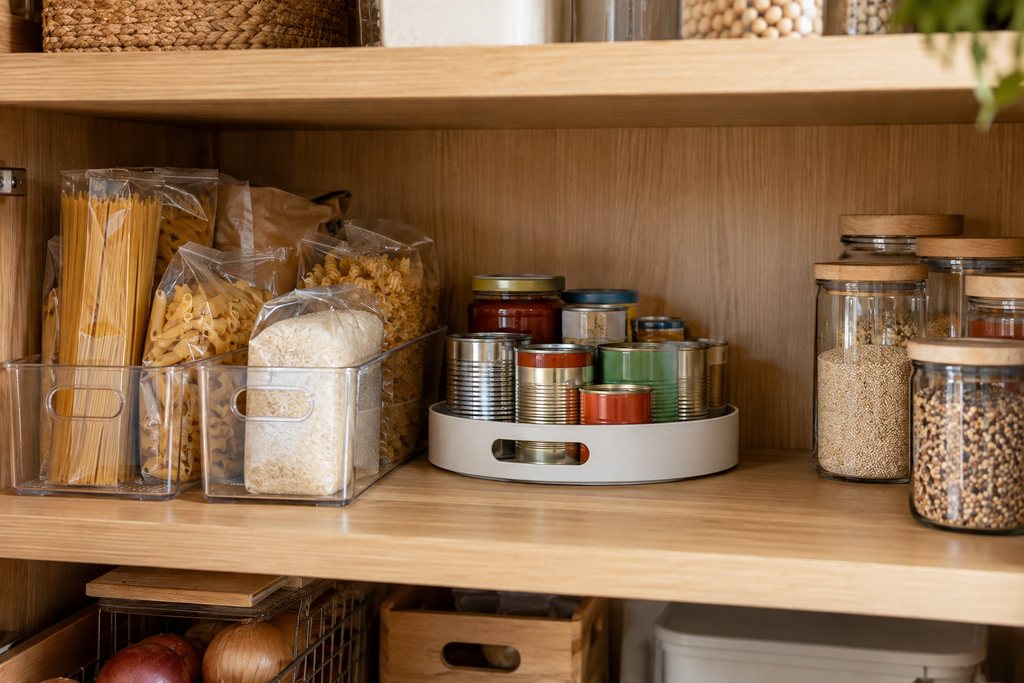
Use first-in-first-out without hiding old food
First-in-first-out means using the earlier purchased stock before newer duplicates when its condition and label instructions allow. Add new packages behind the older ones or keep them in a separate reserve zone. Place opened packages at the front so you do not open a second one by mistake.
Create a small use-next area for ingredients approaching their recommended date or already opened. Add those ingredients to the meal plan rather than leaving them in a warning basket permanently. Rotation does not make damaged or improperly stored food safe.
The USDA shelf-stable food guidance recommends cool, dry storage away from temperature extremes and damp locations. Discard suspect damaged cans without tasting their contents. Follow the guidance and package instructions when deciding whether a product is suitable to keep.
Keep a small restocking record
For staples used often, write a normal household quantity rather than treating every empty gap as a buying prompt. Your useful stock level depends on meal frequency, package size and the time between shops. A large household and an occasional cook need different reserves.
Before shopping, check the active zone and the reserve zone together. Add the exact item needed to the list. If a reserve bin is full, use what you have before buying another multipack.
For shared kitchens, use a visible label for foods reserved for a specific person or dietary need. Do not assume that moving a product into a matching container removes its allergen risk. Preserve clear information and use separate handling where required by the household’s needs.
Maintain the pantry at natural checkpoints
Before shopping, check opened packages and reserves.
When unloading groceries, move older duplicates forward.
During meal planning, choose an ingredient from the use-next area.
After a spill, clean and dry the affected shelf promptly.
Periodically review categories nobody uses and adjust their space.
If pests or moisture appear, address the source and affected food before rearranging containers. A tidy shelf does not solve an infestation or a leak.
Use a grocery shop as a practical layout test
After assigning the zones, put away one normal grocery shop before finalizing labels or buying additional containers. Start with the foods used most often. Can you return a cereal box without shifting the baking supplies? Can you place a new packet behind older suitable stock without emptying the shelf? Mark any category that requires several unrelated movements. Those movements show where the arrangement needs more usable room.
For example, imagine that a household regularly buys pasta, rice and canned beans but rarely uses cake decorations. Give the meal staples a larger working section and keep the decorations in a small occasional-use container. When a cooking habit changes, revise that allocation. Pantry zones describe current use; they do not need to stay the same simply because the original labels looked balanced.
Leave a clearly identified place for a temporary meal plan or shopping note. A simple list on paper or a shared phone note can record what is running low without requiring a complete digital inventory. The list is useful only if someone checks the reserve zone before adding an item. Otherwise an apparently empty working container can lead to another duplicate purchase.
Make the arrangement understandable to another person
Ask someone else in the household to find several ingredients and put away a few packages. If they need an explanation for every shelf, simplify the labels or combine overlapping categories. Use familiar names such as breakfast or baking rather than a classification that makes sense only to the person who organized the pantry. Preserve product information even when the shelf label is clear.
For shared food storage, agree on which supplies are communal and which belong to a particular person. Give personal items a visible boundary without dispersing the everyday meal ingredients across several shelves. Review the arrangement when household members, shopping frequency or cooking routines change. A pantry that another person can maintain is more likely to stay useful between major cleanouts.
Frequently Asked Questions
Should every pantry item go in a clear container
No. Use containers for items that become easier to handle or protect with suitable storage. Keep original packaging when it is convenient or carries information that would otherwise be lost.
How do you organize a pantry on a small budget
Start with inventory, clear labels and a shelf map. Reuse clean containers appropriate to the contents and buy an organizer only for a demonstrated access problem. Category boundaries often help before new products do.
What should be stored on the top shelf
Light, occasional items that an adult can retrieve safely are better candidates than heavy cans or large bulk bags. Put regularly used food at a comfortable reach and match every shelf load to its rating.
How does first-in-first-out pantry rotation work
Place newer duplicates behind older suitable stock and keep opened packages visible. Check condition and storage instructions before use; rotation does not make damaged or improperly stored food safe.
How much space should you leave above pantry containers
Leave enough room to grip the container and remove its lid without tilting or disturbing nearby food. Test your actual packages and hand movement before fixing shelf positions; there is no single gap that suits every container.
Conclusion
To put pantry organization ideas into practice, pantry organization becomes useful when it connects storage with the way your household shops, cooks and uses food. Build a few clear zones for everyday meals, breakfast, baking, snacks and reserves, then place each category at a suitable reach. Measure shelves and openings before buying containers, and keep original packaging wherever it remains convenient. Matching jars are optional; visible ingredients, readable product information and a straightforward place for groceries matter more to the daily routine.
Keep the pantry working by checking both active food and reserves before shopping, moving newer duplicates behind older suitable stock and using opened ingredients in upcoming meals. Review the use-next area regularly instead of letting it become another forgotten shelf. Follow product storage instructions, deal with moisture or pests promptly and revise any category that repeatedly overflows. Start with the shelf that causes the most searching, then extend the same clear zoning and rotation habits across the pantry as your household’s needs change.
