

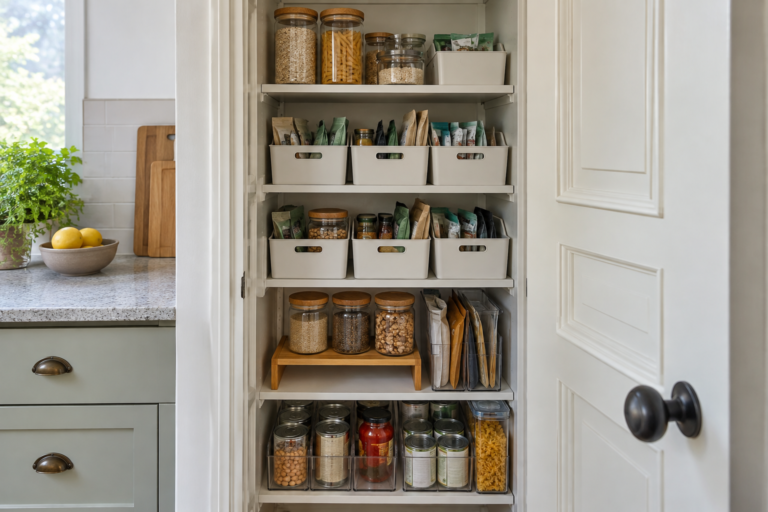
The best small pantry organization ideas improve visibility and access before adding storage. Use the front of each shelf for daily food, put duplicates in a defined reserve and choose bins that pass through the opening easily. For deep shelves, make the back reachable with removable bins or suitable pull-outs.
The goal is usable space rather than the highest possible package count. A pantry packed to its edges can make groceries harder to find and return. These 20 ideas address narrow pantry closets, deep cupboards and tiny kitchen storage without rebuilding the whole pantry system.
Small pantry organization ideas: Choose the layout before choosing organizers

| Space | Start here | Avoid |
|---|---|---|
| Narrow pantry closet | Shallow shelves or slim category bins | Wide containers trapped behind the frame |
| Deep cupboard | Removable front bins and labeled rear reserve | Two loose rows of mixed food |
| Tiny shallow cabinet | One visible row and adjusted shelf heights | Bulky baskets that waste usable depth |
| Corner pantry | Accessible corner turntable or separate side zones | Daily food in the hardest rear corner |
For food zones and rotation, use the main pantry guide. This article focuses on making those zones fit smaller spaces.
Small pantry organization ideas: Twenty ways to recover usable pantry space
1 Measure the narrowest opening
Check the clear doorway between hinges and trim. A bin that fits the shelf width may still be too wide to remove. Record the shelf dimensions and the opening separately.
2 Keep one daily layer at the front
Place the foods used most often in one visible layer. Reserve the rear for duplicates of those same items, not unrelated ingredients that disappear behind breakfast cereal.
3 Use a removable bin on deep shelves
Group small packets in a bin you can lift out comfortably. Choose a modest size rather than one container holding the entire shelf’s weight. Label its front with a broad category.
4 Separate reserves from open packages
An active package and its refill do not need equally convenient positions. Give unopened duplicates a labeled space so they stop competing with the ingredients used every day.
5 Adjust shelf heights to actual food
Move adjustable shelves to suit your common packages. Test lid removal and hand access before reducing vertical gaps. A tight fit is unhelpful if the container has to tilt and spill.
6 Use one stable riser for small jars
A riser can reveal short jars behind a front row. Check that the rear jars remain easy to pick up and that the riser sits securely. Skip it where the shelf is too low.
7 Choose a turntable for the right corner
Use a turntable for bottles or jars in a corner that otherwise requires reaching around items. Check the full rotation. Circular organizers leave unused space at the corners, so they are not ideal for every shelf.
8 Put packets upright
Stand small sachets in a shallow container with the labels visible. Avoid mixing tall bags and tiny packets in a deep basket where the smallest items sink to the bottom.
9 Use door storage only when it clears
Close the empty door with a temporary cardboard depth guide before buying a rack. Account for the food’s protrusion as well as the rack itself. Follow mounting and load instructions.
10 Keep heavy food on suitable lower shelves
Place heavy bulk packages where they can be lifted safely and supported properly. Do not use the door for a large collection of cans unless the system is designed for that load.
11 Decant selectively
Transfer a frequently used dry ingredient only when a suitable food container makes it easier to handle. Keep the original ingredient, allergen, lot, date and preparation information. Matching jars are not required.
12 Size containers for the refill
Check container capacity against the amount usually purchased. A jar that leaves half a bag outside it creates two storage jobs. If a large container is awkward to lift, use a smaller working container and a separate reserve.
13 Give flexible bags a boundary
Clip opened bags as appropriate and place them in a narrow category bin. The boundary prevents slumping into nearby zones. Keep the bin easy to pull out and wipe clean.
14 Limit snack subcategories
Use a few broad groups such as lunchbox snacks and shareable snacks. Too many small bins consume shelf width and make returning groceries unnecessarily complicated.
15 Use a small meal-starting bin
Place a few shelf-stable ingredients for an upcoming meal together if it helps your routine. Keep this temporary zone small and return leftover ingredients to their categories after cooking.
16 Keep seldom-used tools elsewhere
Move appliances and serving pieces that crowd food shelves to another suitable location. If the pantry must hold them, assign a defined section so they do not gradually take over daily food access.
17 Label the shelf edge
Use shelf labels when containers would take up too much room. A label such as rice and pasta marks the category without adding another object to a tiny cabinet.
18 Reserve a small use-next section
Put opened or older suitable food where it will prompt meal planning. This area should remain small and active. It is not a place to accumulate products nobody intends to use.
19 Match buying quantities to available storage
Before buying a multipack, decide where it will fit and when it will be used. A bulk discount does not improve a pantry if the package blocks the items needed every day.
20 Test the layout with one grocery unload
Return a normal shop to the pantry. If putting groceries away requires removing several unrelated bins, simplify the arrangement. Repeat the test after any shelf-height change.
Small pantry organization ideas: An example for a deep pantry closet
| Shelf area | Front zone | Back zone |
|---|---|---|
| Upper | Light baking bin | Labeled occasional packets |
| Middle | Breakfast bin that lifts out | Breakfast reserve only |
| Lower middle | Visible meal staples | Matching unopened refills |
| Low | Safely manageable heavy food | Leave inaccessible areas unused rather than hiding daily items |
In this example, a removable front bin provides access to the rear. It is useful only if the user can lift it safely. If lifting is difficult, choose accessible shallow storage or a professionally suitable pull-out instead.
Food pantry organization ideas should not move shelf-stable food into hot or damp locations simply to gain room. The USDA storage guidance recommends a cool, dry place away from temperature extremes. Follow each product’s storage label.
A fit checklist before spending money
Does the organizer pass through the narrowest opening?
Can you lift or slide it when loaded?
Does the door close with the tallest package in place?
Can you read labels without removing the entire shelf?
Is the shelf or mounting system rated for the intended load?
If the pantry later expands into a room, the walk-in pantry guide covers circulation and larger storage zones.
Compare three small-space arrangements in everyday use
For a narrow pantry closet, start with one accessible row of everyday packages and a separate reserve section. Test the widest container through the opening while neighboring food remains in place. If it must be turned sideways and emptied to come out, the arrangement needs a narrower container or fewer items in that zone. Shelf space that cannot be reached comfortably should not hold the ingredient needed every morning.
For a deep cupboard, treat the front and back as different storage positions. Place active meal staples at the front and matching unopened refills behind. A removable front bin can help only when its loaded weight is manageable. Try taking out the bin, retrieving a rear package and returning both. If that sequence is troublesome, reduce the bin size or choose a different access method rather than filling the rear more densely.
For a shallow cabinet, avoid buying deep baskets simply because they belong to a matching set. Shelf-edge labels may provide enough organization while leaving the full depth available for food. Keep short jars visible and test any riser with the tallest item on it. Use the door only when the selected organizer and the food inside it leave the cabinet closing properly.
In each example, keep a small amount of flexible space within the relevant category for the packages normally brought home. This does not mean leaving an entire shelf empty. It means avoiding a layout so precise that a slightly different cereal box or refill bag has nowhere to go.
Fix the recurring obstruction first
If the same item is repeatedly left on the counter, examine its assigned home. The shelf may be too high, the category may be overcrowded or the organizer may require both hands while the user is carrying groceries. Move that item into a more workable position and test again. Small pantry organization ideas are most useful when they address these specific everyday obstacles rather than adding storage that makes the cupboard harder to use.
Frequently Asked Questions
How do you organize a pantry that is very deep
Put everyday food at the front and related reserves behind it. Use manageable removable bins or a suitable pull-out so the rear stays reachable. Avoid loose mixed rows.
Can a pantry door hold all the canned food
Only use door storage within the specific system’s mounting and weight limits. Heavy cans are often better on suitable fixed shelves; door clearance and hinge capacity also matter.
What is the first change to make in a tiny pantry
Remove duplicates from the active zone and make daily food visible. That shows whether the real problem is shelf depth, excess stock or an organizer that does not fit.
Can a small pantry work without decanting food
Yes. Keep suitable original packages grouped by category, close opened bags appropriately and label shelf edges. Decant only when a food-contact container improves handling, while retaining the original product information.
How do you choose bins for narrow pantry shelves
Measure both the usable shelf and the narrowest opening. Check the bin’s outside dimensions, handles and loaded weight, then confirm that it can be removed and returned without blocking the door or neighboring food.
Conclusion
To put small pantry organization ideas into practice, a small pantry gains usable space when food becomes easier to see, reach and return. Begin with the shape of the storage: narrow closets need organizers that pass through the opening, deep shelves need accessible rear reserves, and shallow cabinets benefit from simple visible rows. Separate daily supplies from unopened duplicates and use shelf height according to the packages you actually buy. Choose each bin, riser or turntable to solve a specific access problem rather than to fill every available gap.
Test the arrangement while unloading a normal grocery shop and adjust anything that makes the process awkward. If a container has to be lifted heavily, tilted through the frame or removed before several unrelated items can be reached, simplify that section. Keep labels and food information available, follow appropriate storage conditions and buy quantities the pantry can reasonably hold. A few well-sized zones, a small use-next area and a quick pre-shopping check can make a compact pantry easier to maintain without adding bulky storage or duplicating the main pantry system.
