

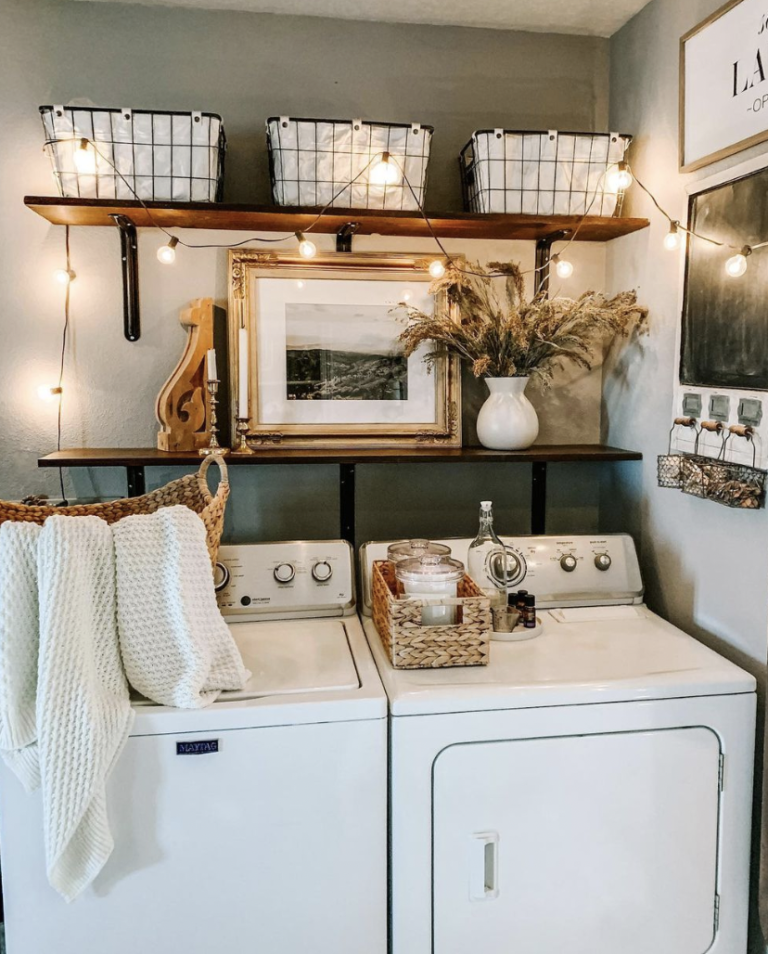
Small laundry room organization ideas should preserve machine access first, then use adjacent walls, shallow cabinets and portable work surfaces for storage. Keep one active load in the room and move reserve supplies and finished clothing to suitable destinations. A tight laundry area usually benefits more from a clear workflow than from another floor-standing unit.
Whether you have stacked machines, a narrow room or a laundry closet, measure with every door, lid and drawer open. Plan storage around the installation requirements rather than filling every apparent gap.
Small laundry room organization ideas: Match the solution to the space

| Setup | Storage approach | First check |
|---|---|---|
| Stacked machines | Narrow side storage and portable folding surface | Approved stack configuration and control access |
| Narrow side-by-side room | Shallow wall storage and a limited sorting zone | Machine-door and walking clearance |
| Top-loader nook | Side shelf or cabinet, not a fixed cover over the lid | Full lid opening and loading reach |
| Laundry closet | Suitable wall storage plus outside sorting space | Ventilation, access and door closure |
Use the full laundry room guide for chemical storage and the complete sort-to-return routine. This guide concentrates on the footprint and access problems of smaller installations.
Small laundry room organization ideas: Nineteen ideas for tight spaces
1 Record the full open footprint
Measure doors, lids and drawers while fully open. Include the space you need to stand and lift a basket. A cabinet that fits beside a closed washer can still obstruct loading.
2 Keep appliance clearances as specified
Read the model’s installation instructions before adding shelving or enclosing machines. Clearances and ventilation vary by equipment. Do not assume a gap is spare storage space.
3 Stack only an approved combination
Use stacking only where the manufacturer permits the appliance combination and specifies the kit and installation. A dryer placed on a washer without an approved arrangement is not a storage solution.
4 Choose one accessible side cabinet
In a stacked setup, a narrow adjacent cabinet can keep supplies convenient. Test the cabinet door against the machine doors and choose secure storage for adult-only products.
5 Use shallow shelves above reachable space
Shallow shelves can make small supplies visible without projecting into the working area. Follow fixing and load instructions. Avoid placing heavy refills overhead.
6 Keep over-machine storage independently supported
A properly installed shelf or counter should not rely on an improvised arrangement on vibrating machines. Check lids, hoses, controls and service access. An unsuitable shelf above a top loader can make washing harder.
7 Put the folding surface beside a top loader
Use a small side work surface if the room allows it. If there is no side space, fold elsewhere instead of using a surface that repeatedly obstructs the washer lid.
8 Try a portable folding board
A portable board or small table can provide a temporary work area outside the machine zone. Store it in an assigned place and check that it is stable during use.
9 Use a wall-mounted fold-down surface carefully
Test the open footprint before installation. The surface needs suitable mounting and a clear route around it. Fold it away after use so it does not become permanent hallway obstruction.
10 Keep a drying rack’s open footprint clear
Choose a rack by its open dimensions, not its folded size. If it blocks the doorway, air-dry in another suitable location rather than squeezing it into the room.
11 Use a short hanging zone
Install a suitable rod where garments can hang without touching equipment or blocking controls. Use it for the current load, not the whole household’s spare hangers.
12 Sort laundry outside the closet
For a laundry closet, place hampers in suitable bedroom or bathroom spaces and bring in the load being washed. This keeps the appliance opening usable.
13 Limit the active supply
Keep a safely stored working quantity near the machines and put excess stock in suitable secure storage elsewhere. Do not turn every gap into a chemical-storage pocket.
14 Keep laundry chemicals labeled and secured
Retain original packaging and follow storage instructions. Laundry packets belong sealed, locked and out of children’s sight and reach. A high open shelf alone should not be treated as locked storage.
15 Use the door only if it still works properly
Check closure, ventilation and access before adding an organizer. Avoid covering louvers or projecting into hoses and controls. Follow mounting and load instructions.
16 Try a slim cart only where access remains clear
A cart can help in a genuine unused side gap. It is unsuitable if it blocks ventilation, connections, servicing or movement. Measure the cart loaded with bottles and check that it can be retrieved safely.
17 Give small tools one shallow container
Place a lint brush, garment bags and other suitable tools together. Keep sharp and small items away from young children. One defined category prevents many little objects from spreading across the machines.
18 Move finished laundry out promptly
Use a return basket and take it to the room where the clothes belong. A small laundry area cannot function well when several clean loads remain parked beside the machines.
19 Leave one clear maintenance route
Do not permanently box in the vent, connections or access panels. Storage should be removable where service requires access. A layout that prevents maintenance needs revising even if it looks tidy.
Small laundry room organization ideas: A compact laundry closet map
| Area | Recommended job | Keep clear |
|---|---|---|
| Beside the machines | Suitable narrow secure supply storage | Door movement and connections |
| Above usable wall space | Light tools on properly mounted shelves | Ventilation and controls |
| In front of machines | Loading and unloading | Floor-standing overflow |
| Outside closet | Sorting and portable folding | Household circulation |
This arrangement separates the appliance footprint from the work areas that can happen elsewhere. It is especially useful when a closet has room for equipment but no safe permanent folding counter.
Test a proposed organizer before buying
Use cardboard to represent its depth and width. Open the machine, stand in the loading position and carry a full basket through the route. If the mock-up forces you to twist awkwardly or move it each time, choose a shallower solution or move that storage outside the room.
For example, an organizer 8 inches deep occupies 8 inches of the route wherever it projects into it. That does not establish whether the remaining space meets accessibility or installation requirements. Check the actual user movement and applicable requirements rather than relying on a generic minimum.
Keep dryer care possible in a small room
The U.S. Fire Administration dryer safety guidance recommends cleaning the lint filter before and after each cycle and keeping the dryer properly installed and serviced. Leave room to reach the filter and maintain the vent system.
Do not use a laundry storage project to improvise electrical, gas or vent changes. Follow the appliance instructions and use appropriate professional help for installation work.
For the clothes leaving this space, the small closet guide can help make their final destination easier to use.
Run a compact-space trial before buying storage
Use an ordinary laundry session to test the proposed arrangement with the equipment fully accessible. Open the appliance doors or lid, carry a basket through the route and reach the controls. Then place a cardboard outline where a cart or cabinet would stand. If carrying the basket becomes awkward, the proposed storage is taking space from the task it is supposed to support.
For a laundry closet, try moving the sorting basket and folding step into a suitable nearby area. Bring only the active load to the machines and return supplies to their secure location after use. This can reduce the number of objects competing inside the closet. Keep the nearby area clearly defined so laundry does not gradually spread across the household route.
For a narrow room, compare a shallow side shelf with a deeper cabinet using the same trial. A cabinet may hold more but require additional room for its door and the user standing in front of it. A shelf may be easier to reach but unsuitable for supplies that require secured storage. Choose each location by what it will hold and how it will be used, while preserving the appliance’s specified access and clearances.
Keep a short note of the remaining problem after each trial. Perhaps hangers need a better home, the return basket is oversized or a portable folding surface has no place to go when stored. Address one problem at a time instead of buying a coordinated set of organizers. Small laundry room organization ideas work best when the full arrangement remains manageable during washing, unloading, drying and resetting, rather than only when everything is put away.
Frequently Asked Questions
Where can you fold clothes without a counter
Use a stable portable surface or another suitable room. A dedicated nearby folding spot can work better than a counter that blocks loading or movement.
Is every gap beside a washer suitable for a cart
No. Some gaps are needed for the installation, airflow, connections or service. Check the model instructions and actual access before adding storage.
How do you keep a laundry closet organized
Bring in only the active load, keep products safely stored, fold outside the closet where necessary and move finished clothing out. Protect the appliance opening and ventilation.
Can any washer and dryer be stacked to save space
No. Stack only a combination the manufacturer permits, using the specified stacking kit and installation method. Check control reach and service access as well as the floor space saved.
Can you add storage to a laundry closet door
Only if the organizer preserves required ventilation, full door closure and appliance access. Do not cover louvers or interfere with controls and connections, and follow the organizer’s mounting and load instructions.
Conclusion
To put small laundry room organization ideas into practice, a small laundry space works best when the appliance footprint stays usable and flexible tasks happen where there is room for them. Measure with doors and lids open, preserve the model’s required clearances and choose shallow adjacent storage instead of filling every gap. In a laundry closet, sorting and folding may work better outside the enclosure. For stacked machines, check the approved combination and installation rather than treating stacking as a universal solution to limited floor space.
Keep only the active load and safely stored working supplies near the machines, then move finished laundry to its destination promptly. Test a proposed cart, cabinet or drying rack in its open and loaded position before committing to it. Remove any addition that blocks ventilation, connections, maintenance or the household route. When the space feels crowded again, identify the specific action that has become difficult and adjust that part of the layout. A compact system stays useful when it makes loading, unloading and returning clothes simpler without creating new access problems.
