

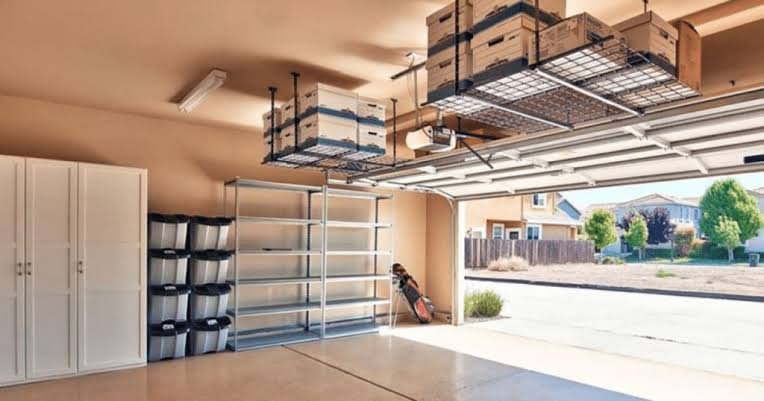
Good garage ceiling storage ideas put occasional-use belongings above the daily working area while preserving garage-door movement, vehicle clearance and a practical retrieval method. Start by measuring the complete operating space and identifying the ceiling construction. Then select a storage system whose installation instructions match that structure and the items you intend to store.
Overhead space is useful only when the household can access it comfortably. A large rack that requires moving a car, clearing furniture and lifting awkward bins may be less practical than a smaller wall shelf. Choose the position and access routine together rather than treating capacity as the main purchasing decision.
Garage ceiling storage ideas: decide whether overhead storage suits your belongings
Seasonal decorations, empty luggage and infrequently used outdoor accessories are possible candidates when their condition and storage requirements permit. Everyday shoes, regularly used tools and supplies needed in a hurry usually belong lower down. If a person needs an item several times each week, the extra retrieval steps deserve close attention.
Make three groups: items worth keeping overhead, items that need accessible storage and items that should leave the garage. Write the packed dimensions of every proposed container. The outside measurement matters, including handles and lid overhangs. Two bins with identical advertised volume may fit a shelf very differently.
For the whole-room arrangement, use our garage storage planning guide. Decide where cars, bikes, tools and garden equipment belong first. Overhead garage storage ideas should support that plan rather than claim space already needed for movement or equipment operation.
Use an access test before choosing a rack
Imagine removing the heaviest proposed container. Where would you stand? Where would it be placed after removal? Could another person walk through while retrieval takes place? If the answers depend on balancing a bin over a car or stretching from an unsuitable ladder position, change the layout before shopping.
An occasional-use item can still be difficult to retrieve. A camping tote needed four times a year may be bulky and awkward, while a light ornament box is manageable. Classify items by handling difficulty as well as frequency. Put the easiest-to-handle containers in the overhead category and retain lower storage for awkward equipment.
Measure the garage as an operating space
Draw a simple ceiling plan on paper and mark the door tracks, opener, lighting and other visible equipment. Add the parked vehicle’s position, including roof racks and any changes you expect. Measure from the floor to the lowest part of each obstruction, not only to the ceiling surface.
Operate the garage door through its full travel while observing from a suitable location. Record the space it occupies when closed, moving and fully open. A clear corner with the door closed may not be available when the panels travel upward. Do not modify tracks, springs or the opener to make a storage system fit.
A clearance worksheet you can reuse
The following numbers are an illustrative measuring exercise, not installation clearances or a safety approval. Suppose the ceiling is 108 inches above the floor and a proposed rack deck would sit at 90 inches. If the tallest vehicle projection is 82 inches, only 8 inches remain beneath the deck before accounting for the rack’s lowest hardware. That calculation is a reason to check the design carefully, not a recommendation that the gap is adequate.
| Measurement | Record this detail | Why it changes the plan |
|---|---|---|
| Floor to ceiling | Lowest point in proposed area | Sets the available vertical envelope |
| Door movement | Entire travel path | May remove apparently usable space |
| Vehicle height | Roof accessories included | Determines the real parked profile |
| Rack underside | Deck, brackets and hanging accessories | May be lower than the advertised deck height |
| Retrieval location | Standing area and bin landing spot | Determines whether access is practical |
| Container height | Lid and handles included | Controls shelf spacing and loading access |
Include utilities and access panels on the drawing. Leave required service access, lighting coverage and ventilation arrangements intact. Ask the relevant installer when a proposed rack position conflicts with equipment rather than assuming the equipment can be moved easily.
Match the system to the ceiling construction
The storage unit and the building structure are separate parts of the load path. A product’s advertised capacity does not establish what your garage ceiling can support. Identify the construction and obtain qualified advice when the supporting structure, condition or installation requirements are uncertain.
The SafeRacks overhead-rack manual specifies mounting conditions, size-dependent static-load limits and a distribution pattern. It also warns against climbing or hanging from the rack and calls for routine inspections. These are instructions for the covered products, not a universal ceiling-storage specification. Use the current manual for the exact model purchased; professional assessment may be needed for the building itself.
Keep the instructions, purchase details and installation information together. Record which product was fitted and where. If a future homeowner or family member adds hanging accessories, they should be able to identify the system rather than infer its capacity from appearance.
Compare practical overhead storage arrangements
Fixed ceiling racks for seasonal containers
A fixed rack works best when containers can be reached without disrupting daily activities. Choose the rack footprint from the actual bins and the retrieval direction. Label the visible sides and arrange categories so the first container needed is not trapped behind several unrelated boxes. Avoid making a deep rack into an unsearchable second attic.
A smaller rack beside a parking bay
One narrow rack can be more useful than covering the whole vehicle area. The adjacent floor can become a planned loading location when retrieval is necessary. Measure the side access with the car parked and the garage door open. If the rack can only be reached after extensive rearranging, reduce its size or choose a different zone.
A purpose-built lifting platform
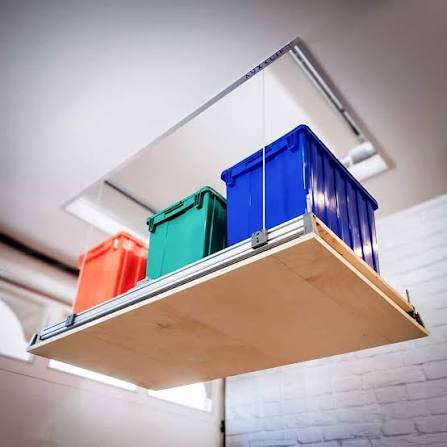
A lowering system may reduce the need to handle containers at full ceiling height, but it introduces its own installation, operating and maintenance requirements. Plan where the platform will descend and whether that floor area can stay available. Check the exact product’s controls, locking arrangements and instructions; do not assume every powered or manual lift works alike.
Dedicated overhead equipment storage
Long sporting equipment needs a system intended for its shape and weight. Measure the whole object, including bindings, paddles or attachments, and plan how it will be removed. Separate equipment storage from the bin rack unless the manufacturer expressly permits the arrangement. Accessories should be compatible with the specific supporting system.
High wall storage as an alternative
An upper wall shelf can sometimes provide easier side access than a ceiling rack. It still requires appropriate support and installation, but its arrangement may suit shallow containers better. Compare the reach and retrieval process honestly. Our DIY garage storage projects include lower and portable options when overhead storage creates unnecessary handling work.
| Arrangement | Useful for | Main planning question | Poor match when |
|---|---|---|---|
| Fixed rack | Occasional seasonal bins | Can each bin be reached and lowered? | Access requires awkward lifting |
| Narrow side rack | A small reserve category | Is the loading area available? | Parking prevents retrieval |
| Lowering platform | Containers accessed through a clear descent area | Can the full operating area remain clear? | The floor is permanently occupied |
| Dedicated equipment system | Compatible bulky gear | Does the system match the object? | Accessories or weight are incompatible |
| Upper wall shelf | Shallow reserve containers | Is side access easier? | The wall cannot support the installation |
Set a container and loading policy
Choose containers people can handle when full. A large tote is not automatically efficient if its contents make it difficult to lift. Split one category into smaller clearly labeled containers when necessary. Give each container a name, an inventory card and a designated position on the rack map.
A useful map might divide the rack into holiday supplies, summer equipment and spare household accessories. Put the inventory on a clipboard at ground level. The map reduces the temptation to climb up simply to discover which box contains an item. Update it when containers move, and leave unused space rather than squeezing in an unidentified tote.
Track the stored load in the way the product instructions require. Include permitted accessories and their contents, and account for any shared limitations specified by the manufacturer. A handwritten inventory is an organizational aid; it does not replace the equipment’s instructions or establish a safe capacity for the structure.
Keep unsuitable items out of the overhead zone
As a practical selection policy, exclude fuel, loose sharp objects, fragile glass and containers likely to leak. Keep dense materials and awkward machinery in a more appropriate location. Some items need storage conditions a garage does not provide, regardless of shelf height. Read their labels and choose the location from those requirements.
Do not place emergency supplies where several storage steps are needed to access them. Keep anything required during a power outage reachable without relying on a powered lift. An overhead system should not become the only route to essentials, especially when the household’s access abilities vary.
| Proposed item | Better decision |
|---|---|
| Light seasonal accessories | Consider a manageable labeled container |
| Frequently used repair kit | Keep in an accessible tool zone |
| Fuel or leaking chemicals | Use the storage arrangement required by the product and local rules |
| Dense, difficult-to-handle supplies | Select an appropriate lower location |
| Unidentified mixed box | Sort before assigning overhead space |
Build an inspection and retrieval routine
Keep the floor area used for retrieval free of permanent storage. Before accessing a container, clear the landing location and arrange appropriate access equipment according to its instructions. Plan help for awkward handling instead of improvising while already reaching overhead. Never use the rack as a step or climbing surface.
Review the installation and containers on the schedule required by the manufacturer and whenever an impact, visible change or loose component is noticed. Stop using equipment with unresolved damage or movement. Avoid adding unapproved hooks or altering the system because a different item nearly fits.
Review the inventory at seasonal changeovers. Remove supplies that have not been used, relocate items now needed frequently and replace unreadable labels. The aim is fewer retrieval problems, not a permanently full rack. A smaller collection is easier to handle and easier for the household to understand.
Frequently Asked Questions
How much weight can a garage ceiling rack hold?
There is no universal figure. The exact rack, its installation and the supporting structure determine the applicable limits. Read the model-specific instructions and obtain qualified structural advice where needed. An advertised product capacity is not proof that your ceiling can support it.
Can overhead storage sit above the garage door?
Possibly, but only after measuring the door’s entire movement and checking the storage system’s installation requirements. The closed-door view is insufficient. Tracks, the opener, vehicle height, utilities and retrieval access can all make that area unsuitable for a particular arrangement.
What should I store on an overhead garage rack?
Start with occasional-use items in manageable containers that suit the garage’s conditions. Keep daily tools and essentials accessible. As a practical policy, exclude hazardous, leaking, fragile and very awkward items rather than using overhead space simply because a container fits.
Is a lowering rack better than a fixed rack?
It depends on the household’s access needs and the space available beneath it. A lowering system needs a clear operating area and appropriate installation. A smaller fixed rack may be simpler when containers are easy to handle and rarely retrieved.
Can I install storage into any ceiling material?
No. Installation requirements vary by product and construction type. Do not substitute generic anchors or copy a mounting detail from another system. Identify the structure, follow the exact instructions and seek qualified help when compatibility or structural suitability is uncertain.
Conclusion
Successful garage ceiling storage ideas combine an appropriate system with a workable access routine. Measure the door’s movement, parked vehicle, rack underside and retrieval area before deciding where storage belongs. Identify the ceiling construction and distinguish the rack’s product limits from the building’s structural capacity. Choose manageable containers, retain installation information and create a ground-level inventory so the arrangement stays understandable after the initial setup.
Use overhead space for a carefully selected reserve category, then review it as the household’s needs change. Keep essential and frequently used belongings lower down, protect equipment access and address damage or movement before continued use. A modest rack with clear labels and a dependable retrieval process can be more useful than a large installation filled indiscriminately. The goal is a garage that remains easy to park in, work in and maintain while occasional belongings have an appropriate home.
