

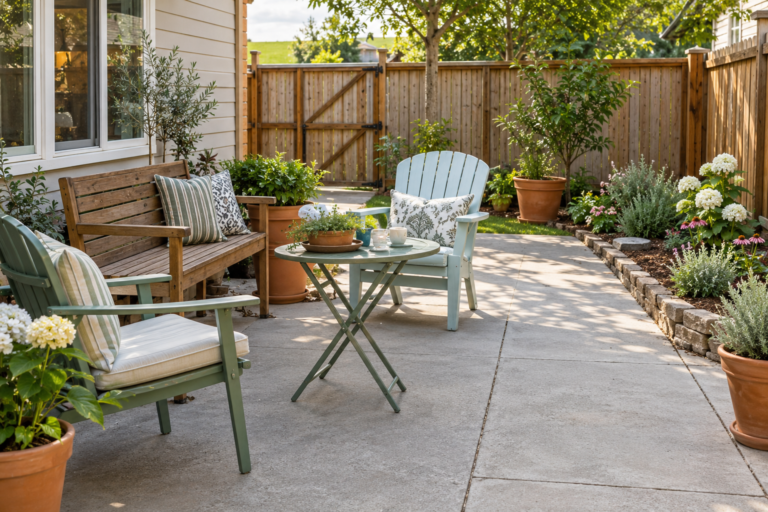
Successful small backyard garden ideas match plants, paths and bed shapes to the conditions already present. Observe sunlight and drainage, measure mature plant spread and choose a limited material palette. Then build one or two coherent planting areas around the way you move through the yard instead of scattering plants wherever a gap appears.
Landscaping changes the yard’s physical structure and growing environment. It deserves a different plan from choosing furniture alone. The 25 designs below focus on plants, borders, pathways, surface transitions and scale, with practical ways to adapt each idea to your light conditions and maintenance capacity.

Small backyard garden ideas: read the site before choosing a design
Mark the sun and shade at several times of day, including the times you use the yard. Repeat the observation when seasonal changes affect tree cover or building shadows. Note dry areas, wet pockets, existing roots and spots where walking has compacted the soil. These details influence what can grow and how new paths should connect.
Check plant information for mature size, light, moisture and local suitability. The University of Maryland Extension planting guide advises selecting trees and shrubs for the site’s sunlight and their full-grown size. Regional planting calendars vary, so use guidance appropriate to your location rather than copying another climate’s schedule.
For the broader arrangement of seating, privacy and activities, begin with our small backyard design guide. Use the landscaping plan to strengthen that layout. A beautiful border will be frustrating if it narrows the only route to a gate or leaves no way to reach plants for maintenance.
25 planting and hardscape designs to consider
1. Create one continuous boundary bed
Join separate planting pockets into a coherent bed along a suitable boundary. Repeat a small number of locally appropriate plants and leave maintenance access where required. A continuous bed can reduce fragmented edging, but it should not become so deep that the back section cannot be reached.
2. Use an L-shaped planted edge
An L-shaped border can frame an open area without enclosing all four sides. Put taller planting where its mature size fits, with lower plants beside the route. This design suits a square yard when one open edge is needed for seating or movement from the house.
3. Plant a narrow yard asymmetrically
Use a more substantial planted area on one side and a simpler edge on the other. Test the arrangement on a scaled drawing before planting. Equal-width borders are not mandatory; preserving a functional route may be more useful than making the two sides visually identical.
4. Turn an irregular corner into a compact bed
Use a small group of compatible plants to soften an awkward pocket. Choose mature sizes that remain within the space and avoid adding a complicated miniature path. The corner should complement the main layout while remaining accessible for watering, pruning and removing unwanted growth.
5. Repeat plants in modest groups
Group suitable plants in repeated clusters instead of buying one of every appealing specimen. Leave the spacing their mature forms require. Repetition can connect beds and make replacements easier, but do not force the same plant into sun and shade locations where its needs differ.
6. Build a simple height hierarchy
Arrange structural planting, intermediate plants and lower edging so the proportions suit the available space. Check mature width as carefully as height. A compact bed does not benefit from tall plants if their eventual spread closes the path or crowds neighboring plants.
7. Choose a locally appropriate small tree
A small tree may provide structure or seasonal interest when the site can accommodate its mature form. Check roots, overhead space and local growing guidance before buying. Include its future canopy on the plan rather than judging the fit from the nursery container alone.
8. Use compact shrubs deliberately
Place shrubs where lasting structure is needed and verify the mature dimensions of the exact variety. “Dwarf” does not mean every plant will suit every narrow border. Leave room for access and consider seasonal appearance so the bed remains useful beyond one brief flowering period.
9. Give a sunny bed a focused role
Choose one purpose, such as seasonal color, locally suitable pollinator planting or a small edible area. Match plants to the actual light and soil. Avoid combining conflicting watering needs simply to include more varieties in the same small space.
10. Design shade planting around the site
Treat shade as a site condition rather than a problem to cover with random plants. Check whether the area is dry beneath established roots or stays moist. Select locally appropriate plants for those conditions and use foliage form and texture to provide interest where suitable.
11. Use containers where planting flexibility matters
Containers can help test a location or add planting where a permanent bed is impractical. Choose adequate containers for the plants and include watering and drainage in the plan. Group a few purposeful pots rather than lining every path with individual obstacles.
12. Keep edible planting compact and reachable
Grow a limited selection that suits the available light and your cooking habits. Position it near a practical watering route and leave room to harvest. Raised beds or containers still require appropriate soil volume, drainage and care; they do not remove those needs automatically.
13. Add a suitable climbing-plant support
A trellis can introduce vertical interest where the support and plant are appropriate. Check mature growth, pruning access and attachment requirements. Do not let climbing planting conceal a gate or service point that must remain reachable throughout the year.
14. Use groundcover for a defined planting role
Choose a locally suitable groundcover to fill a specific bed area, checking mature spread and invasiveness. Keep it out of places requiring a durable walking surface unless it is appropriate for that use. A fast-spreading plant can create more maintenance when its boundaries are unclear.
15. Reduce an awkward lawn fragment
If a narrow lawn strip is difficult to maintain and rarely used, consider incorporating it into a planted bed. Keep lawn where it supports a real activity. Compare the care required by the proposed planting; replacing grass with a complicated collection does not guarantee less work.
16. Draw one purposeful curve
A gentle curve can connect the bed to the yard’s shape, but it should preserve usable width and maintenance access. Mark it with a hose before edging. Avoid repeated tight curves that create small difficult pockets and make mowing or border care unnecessarily awkward.
17. Use straight beds for a clear compact layout
Straight edges can organize a small rectangular yard and simplify the relationship between planting and paving. Test the proportions before installation. A narrow straight bed still needs enough width for the chosen plants; clean lines do not compensate for unsuitable mature spacing.
18. Choose one main path material
Use a surface appropriate to the route, users and site conditions. Consider installation, drainage and maintenance rather than color alone. Repeating the main material can connect sections of the yard and reduce the number of separate finishes that need future repair or replacement.
19. Make stepping stones serve a real destination
Use stepping stones where they provide a practical route to a bed or working area. Test the stride and footing for the people using them before committing. They are a poor substitute for a continuous accessible surface when stable uninterrupted movement is needed.
20. Combine a path with planting access
Position the route so it also lets you reach the bed for care. This can reduce the need for an additional maintenance strip in a small yard. Keep mature plant spread out of the walking area and avoid layouts that require stepping over delicate plants.
21. Use gravel only where its behavior suits the site
Consider containment, movement underfoot, cleanup and migration into adjoining areas. A loose surface may not suit every mobility need or a route used by wheeled equipment. Check the appropriate base and drainage with the installer rather than assuming a thin decorative layer is sufficient.
22. Match edging to maintenance needs
Choose edging that makes sense for the plants and adjoining surface. Check durability, installation and how it will be maintained. Avoid sharp or awkward projections along walking routes, and plan transitions so the edge does not create a small hard-to-clean trench around every bed.
23. Keep existing useful features
Retain healthy, appropriate plants and sound surfaces when they support the new plan. Design around them before proposing removal. Reusing a suitable feature can save work and preserve established structure, but do not retain a poorly placed plant solely because replacing it feels inconvenient.
24. Plan seasonal interest with restraint
Choose a small palette with complementary seasons or foliage forms rather than attempting constant flowers everywhere. Check the exact plants’ behavior in your climate. Include what the yard looks like during the quieter season when deciding which structural plants deserve limited space.
25. Build one complete bed before expanding
Finish its layout, planting and care routine, then observe how it performs. This gives you useful information about watering, light and maintenance before repeating the design. A complete modest bed can provide a stronger result than several half-finished areas needing different materials and attention.
Match the planting strategy to sun, shade and care time
| Site condition | Planning approach | Check before buying | Maintenance question |
|---|---|---|---|
| Sunny and relatively dry | Plants suited to observed light and moisture | Local suitability and establishment care | Can you provide needed watering initially? |
| Shaded with established roots | Planting compatible with shade and root competition | Available soil space and dry versus moist shade | Can plants be reached without disturbing roots? |
| Moist pocket | Investigate the source and appropriate planting | Whether drainage needs correction | Is the condition seasonal or persistent? |
| Limited maintenance time | Fewer suitable plant types and simpler edges | Mature size and care requirements | Which tasks can you sustain regularly? |
Do not hide a drainage problem beneath new paving or treat every wet spot as a planting opportunity. Get appropriate advice before changing levels, drainage or retaining structures. In the United States, the 811 before-you-dig service should be contacted before digging to arrange utility marking; check your state process and whether private lines need separate locating. Elsewhere, use the relevant local service.
Draw the bed at mature scale
Use circles or outlines representing the chosen plants’ expected mature spread. For an illustrative 12-foot border, draw the actual proposed plants rather than assigning a universal number of shrubs. Include space beside the path and any access point. The plant information determines spacing; the border’s length alone does not.
A planting worksheet should list each plant’s local suitability, light needs, mature dimensions and care tasks. Add a seasonal note and replacement alternatives. This keeps shopping tied to the site and prevents an appealing sale plant from becoming an oversized permanent problem.
| Worksheet field | Example information to record |
|---|---|
| Location | Rear bed, left of gate |
| Observed conditions | Afternoon sun; soil condition to confirm |
| Intended role | Structural planting or low border |
| Mature dimensions | From reliable information for the exact plant |
| Care requirement | Watering, pruning and seasonal cleanup |
| Access | Route for reaching and maintaining the plant |
If costs require a phased plan, use our budget small backyard guide to decide which bed or path should come first. Complete useful sections rather than spreading the budget across unfinished borders.
Frequently Asked Questions
What is the easiest landscaping design for a small backyard?
One coherent bed, a limited locally suitable plant palette and a purposeful route can be a manageable starting point. Ease depends on site conditions and care needs. Avoid choosing a design only because its photograph looks simple; check the maintenance behind it.
How do I choose plants for a small garden?
Check local climate suitability, sunlight, soil moisture and mature size. Choose plants for a defined role and include their care requirements in the plan. A plant that looks compact at purchase can become too large for a narrow border later.
Should a small backyard have curved or straight borders?
Either can work. Straight borders suit clear rectangular layouts, while a restrained curve may connect an irregular shape. Test the line on the ground and preserve access. Avoid small tight pockets that complicate mowing, edging or plant maintenance.
Can gravel replace lawn in a small backyard?
It can be appropriate in some areas, but compare footing, containment, drainage, cleanup and the intended activity. Gravel is not automatically maintenance-free or accessible. Keep surfaces tied to how the household uses the yard and obtain installation advice where needed.
How can I landscape a shaded small backyard?
Observe whether the shade is dry or moist and check root competition. Select locally appropriate plants for those conditions, using suitable foliage and form for interest. Preserve access for watering and maintenance rather than filling every shaded gap immediately.
Conclusion
Useful small backyard garden ideas start with site conditions and mature scale. Map light, water and access, then choose coherent beds, suitable plants and a path that serves real movement. The 25 designs offer different ways to organize boundaries, awkward corners, sunny areas and shaded spaces without treating every yard as the same project. A restrained palette and purposeful edges can make the arrangement easier to understand and maintain over time.
Complete one workable section, observe it through normal use and expand only when the next addition has a clear role. Retain useful existing features, keep care requirements visible and investigate drainage or utility concerns before construction. The most satisfying compact landscape is one whose plants have room to grow and whose paths remain easy to use. With thoughtful selection and manageable phases, a small backyard can gain structure and seasonal interest without becoming crowded or difficult to care for.
